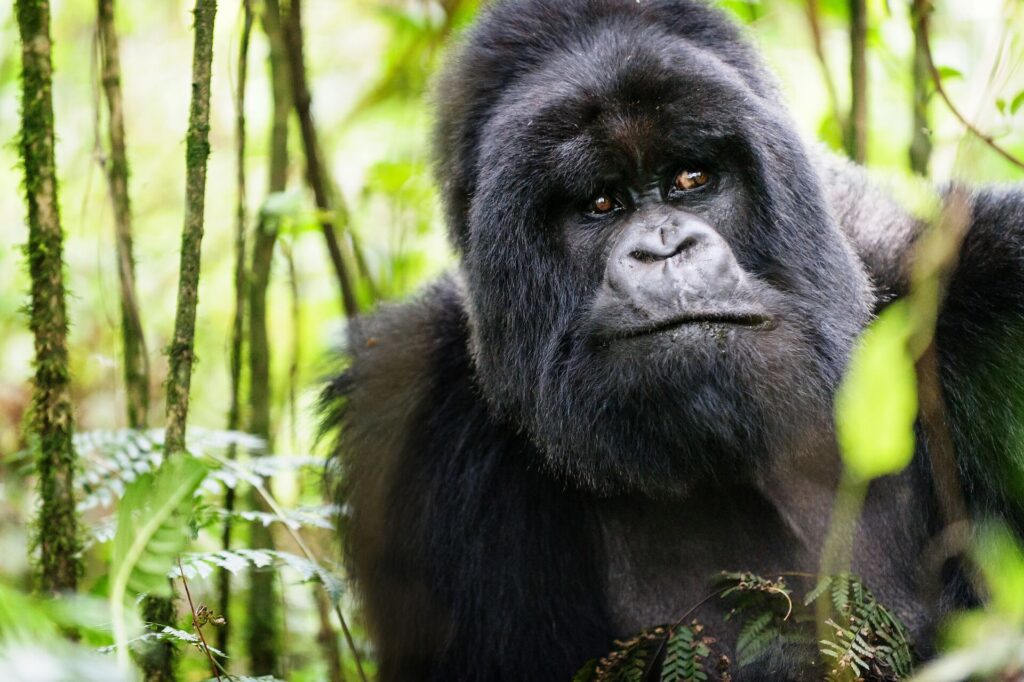

Encountering the greatest of the Great Apes in the wild is one of the most life-affirming experiences a nature lover can have – not least because, as their survival hangs in the balance, your visit helps to secure their future. Read on to discover how to trek to see our closest living relatives in their natural habitats in Rwanda and Uganda, when and where to go, what the experience involves, and how to MAKE TRAVEL MATTER® for gorillas and the communities protecting them.
Why Go Gorilla Trekking?
Coming face to face with a wild gorilla is a deeply moving experience. We share about 98 per cent of our DNA with them, and that becomes fascinatingly obvious when you’re close enough to observe their family bonds, intelligence and individual personalities. Plus, your presence has a measurable benefit: according to the IUCN, there are around 1,063 mountain gorillas left in the wild (around 600 of them adults), and their numbers are slowly increasing. That growth reflects decades of protection and tightly regulated tourism designed to counter habitat loss, poaching, disease linked to human contact and regional conflict in and around their forest homes. Today, conservation-led tourism is still helping to ease those pressures, funding gorilla protection and supporting sustainable livelihoods for neighbouring communities; when you trek to see gorillas where they live, you’re part of that solution. As you hike across steep volcanic slopes and through dense montane rainforests, every quad-burning step is rewarded with spectacular wilderness views – and, ultimately, a wildlife encounter that stays with you long after you’ve left the forest.
Best Time to Go Gorilla Trekking
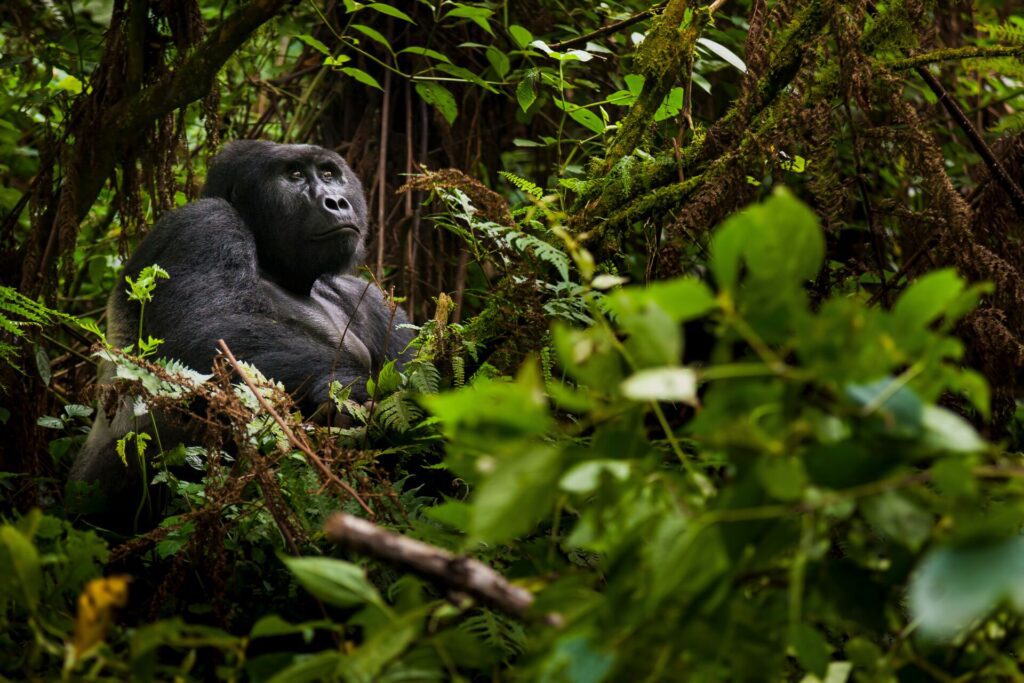
Rwanda and Uganda’s three key parks for gorilla treks – Volcanoes National Park, Bwindi Impenetrable National Park and Mgahinga Gorilla National Park – operate year-round, and because they sit in high-altitude rainforest, their seasonal patterns are fairly similar. The most popular times to go are the drier months, typically June to September and December to February, when trails are less muddy – but permits are also in highest demand. The quieter, wetter seasons (March to May and October to November) bring around 6-7mm of rain each day, which can make steep sections trickier, but the forests feel especially lush and alive. Regardless of when you go, temperatures remain mild for most of the year. Expect daytime highs of about 24-27°C, with cooler mornings and evenings around 7-11°C – and it always pays to stay flexible and prepared for anything in the face of changeable weather conditions.
Adventure World’s 6-day Authentic Gorillas & Chimps holiday is a chance to experience Rwanda’s great apes and experience their conservation first-hand.
Where to See Gorillas in Rwanda and Uganda
While Western gorillas are found elsewhere in Africa, trekking in Uganda and Rwanda focuses exclusively on mountain gorillas (Gorilla beringei beringei). These are the most reliable places to see them.
Volcanoes National Park, Rwanda
As you’ll see on this map, Volcanoes National Park lies in Rwanda’s far northwest, and it’s about 105km from Kigali to the park headquarters area at Kinigi. There are 12 fully habituated gorilla families that the public are permitted to trek to, and alongside them, you might also be lucky enough to spot golden monkeys, critically endangered African forest elephants and some of the 187 recorded species of birds in this UNESCO Biosphere Reserve.
Covering some 160km², the park protects part of the Virunga Mountains, a chain of eight major volcanic peaks straddling Rwanda, Uganda and the Democratic Republic of Congo, with five of them located inside the park itself. Elevation is high, with Mount Karisimbi rising to 4,507m, so trekking routes can climb quickly through bamboo zones and montane rainforest into steep volcanic slopes.
This is also where Dian Fossey carried out her pioneering gorilla research, and where the Dian Fossey Gorilla Fund continues its important conservation work today. As part of Adventure World’s customisable Rwanda and East Africa itineraries, you can see this living legacy first-hand with a MAKE TRAVEL MATTER® Experience at the Ellen DeGeneres Campus of the Dian Fossey Gorilla Fund – a purpose-built conservation and education centre that supports research, community programs and long-term protection efforts, all while deepening your understanding of the mountain gorillas you meet in the wild.
Bwindi Impenetrable National Park, Uganda
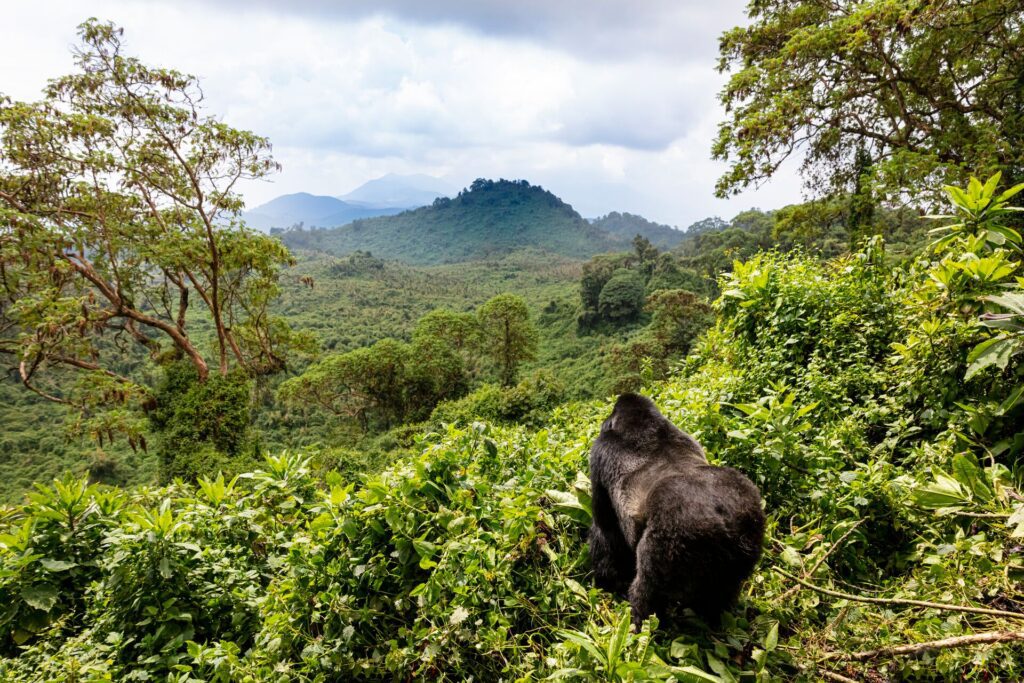
Spanning 321km² in southwestern Uganda, roughly 460km from Kampala, World Heritage-listed Bwindi Impenetrable National Park is home to almost half of the world’s mountain gorillas. There are 15 habituated gorilla groups available for trekking in the park, and it also supports 357 bird species, forest elephants and a range of primates, including chimpanzees, blue monkeys and L’Hoest’s monkeys.
The key to its terrain lies in its name: dense vegetation, tangled undergrowth and steep hillsides combine to create a forest that once proved difficult to penetrate on foot. This is one of Africa’s oldest rainforests, having survived the last Ice Age and existed as continuous forest for around 25,000 years.
Today, trekking routes wind through ridgelines and deep valleys, rising from lowland forest at about 1,160m to Afromontane vegetation above 2,600m. And gorilla encounters here often feel extra immersive, shaped by the forest’s scale, ancient atmosphere and lively biodiversity.
Mgahinga Gorilla National Park, Uganda
Mgahinga Gorilla National Park sits in southwestern Uganda, about 510km from Kampala, on the border with Rwanda and the Democratic Republic of Congo. At just 33.7km², it’s Uganda’s smallest designated wilderness park, yet it protects a critical corner of the Virunga Mountains ecosystem. Trekking here centres on the Nyakagezi group, Mgahinga’s sole habituated gorilla family available for public trekking, which is known for ranging across the wider Virunga area. Despite its compact size, Mgahinga’s biodiversity is massive, supporting mountain gorillas, golden monkeys, forest elephants and more than 115 bird species. The landscape is dramatic and varied too, shaped by montane vegetation, bamboo forests and three extinct volcanoes, with trekking routes spanning elevations from 2,227m to 4,127m.
From gorillas and chimps to spectacular safaris in Akagera National Park, Adventure World’s 7-day Roaming Rwanda itinerary is wildly unforgettable.
Gorilla Groups You Can Trek to See
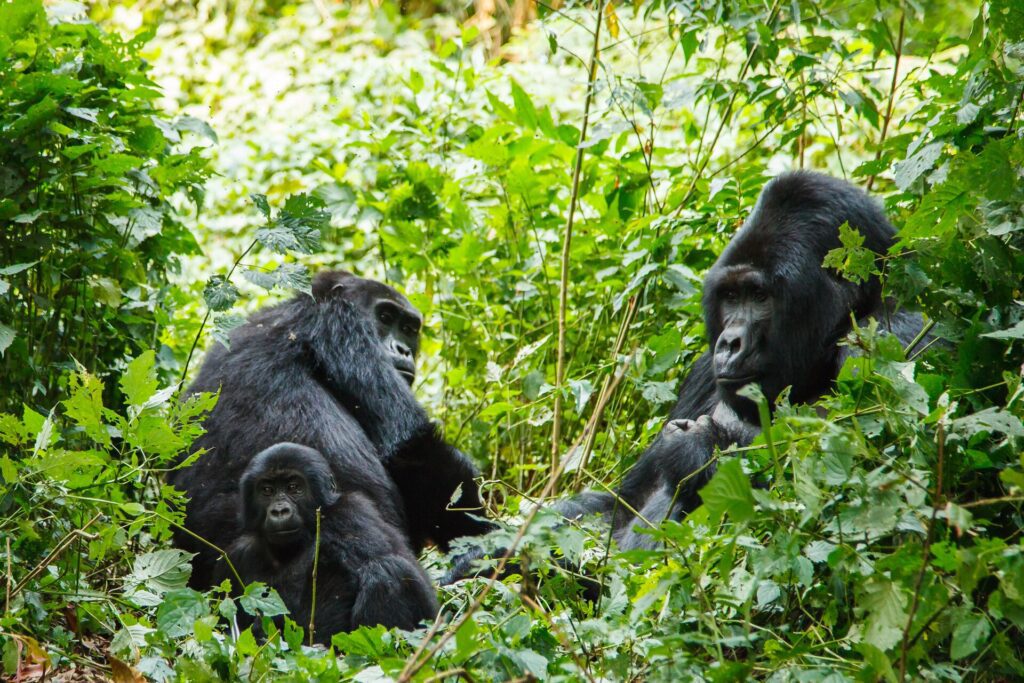
Generally, mountain gorillas live in close-knit family groups of around 10-12 individuals, although the Diann Fossey Gorilla Fund notes that groups can range from as few as two to more than 60. Each group typically consists of related females, their offspring and younger males, and is led by a dominant adult male, known as a silverback.
In Rwanda and Uganda, trekking is limited to only habituated groups, as this allows researchers and authorities to closely monitor their health and ensure all encounters remain ethical. Whichever park you choose, these treks are daytrips only, and your time with the gorillas is strictly limited to one hour.
- Several of Volcanoes National Park’s 12 habituated families were first studied by Dian Fossey, including the Susa group – made famous through her long-term research and the silverback Digit – as well as groups such as Karisimbi and Sabyinyo. Other families you may encounter include Amahoro, Agashya, Hirwa, Kwitonda, Umubano, Bwenge, Muhoza and Isimbi, with trek lengths varying depending on where each group chooses to feed on the day.
- Bwindi’s 15 habituated groups are spread across several trekking sectors. Long-established families include Mubare – in 1993, it became the first group to be habituated in the park – along with Habinyanja, Rushegura, Nkuringo, Bitukura, Oruzogo, Nshongi, Mishaya, Kahungye and Bweza. These groups vary in size and composition due to births, deaths and dispersal.
- In Mgahinga, the Nyakagezi gorilla group usually numbers around 10 individuals, including a dominant silverback, adult females, juveniles and infants. This was also the first family to be habituated in Uganda (in 1991), and it’s known for its relatively predictable ranging patterns.
On our customisable Rwanda’s Gorilla Encounter itinerary, you’ll explore Kigali’s vibrant culture, track gorillas and discover Dian Fossey’s legacy over four epic days.
How to Get a Gorilla Trekking Permit
In each park, daily visitor numbers are capped to protect gorilla welfare and trekking permits are mandatory in both Uganda and Rwanda. These are issued by official government authorities, but Adventure World secures these on your behalf as part of our customisable gorilla trekking itineraries. Each permit allows you to join one guided gorilla trek on a single day, with time spent observing a gorilla group limited to one hour. It’s possible to obtain multiple permits if you’re keen to trek on different days.
Track these gentle giants through the rainforests of Volcanoes National Park as part of our 3-day Gorillas Through The Mist adventure.
Gorilla Trekking Costs and Budgeting
With Adventure World, your gorilla trekking holiday is fully customisable, so your budget will be shaped by how many single-day treks you choose to do and which other experiences you’d like to include. One additional cost to be aware of is a local donation when you visit the Ellen DeGeneres Campus of the Dian Fossey Gorilla Fund in Rwanda, as part of our exceptional MAKE TRAVEL MATTER® Experience there. Your contribution will directly support gorilla research, as well as local conservation and community programs, so it’s money very well spent.
If you decide to hire a local porter on the day of your trek, you’ll pay them directly at the park; expect to pay between USD$10-25, per person, per day, in both Rwanda and Uganda. For many porters, trekking work is a primary source of income, so even if you’re feel confident carrying your own pack, hiring a local is a meaningful way to support the community. It’s also customary to tip your trekking guides and gorilla trackers at the end of your experience – typically that’s around USD$10-20 per guide, and USD$5-10 per tracker, depending on your group’s size.
How Difficult is Gorilla Trekking?
Generally, Volcanoes National Park has the most accessible treks; Bwindi can be the most demanding due to its dense forests and steep terrain, and Mgahinga lies somewhere in between. Whichever park you choose though, gorilla trekking can be physically challenging.
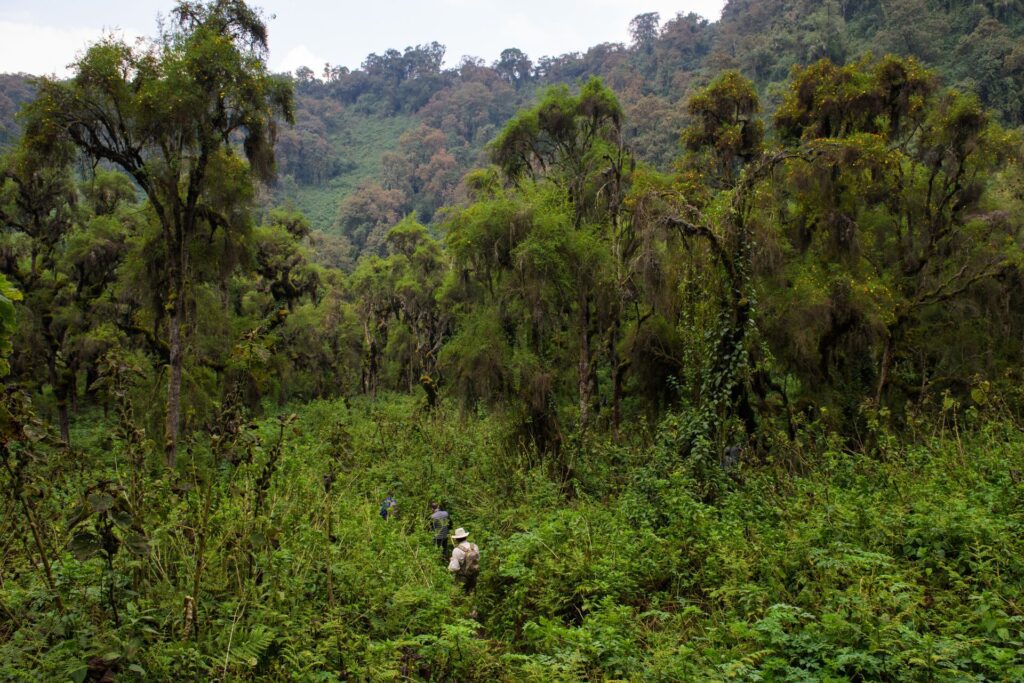
Depending on where a gorilla group is ranging on the day, your hike will last anywhere from 30 minutes to several hours each way, with most treks taking between two and six hours to complete. Invariably, your walk will take place on a combination of forest paths, off-trail terrains, steep slopes, uneven surfaces and muddy sections, and you should be comfortable walking uphill and downhill for extended periods. Altitude might be a factor, too – treks may take place above 2,000m, where thinner air can make exercise feel harder, even for fit travellers. So, a moderate level of fitness is recommended, and you might consider doing some cardio training ahead of your holiday to ensure you’ll get the most out of it. You should also chat to your GP before your trip to ensure you’ll have any relevant medications for altitude sickness on hand, just in case.
For adventurers with mobility challenges, it’s possible to do the trek in all three parks via a sedan chair or stretcher carried by porters – this comes at an additional cost and must be arranged in advance: chat to Adventure World’s Africa Destination Experts on 1300 363 055 (AU) or 0800 238 368 (NZ) for details.
What to Expect on a Gorilla Trek
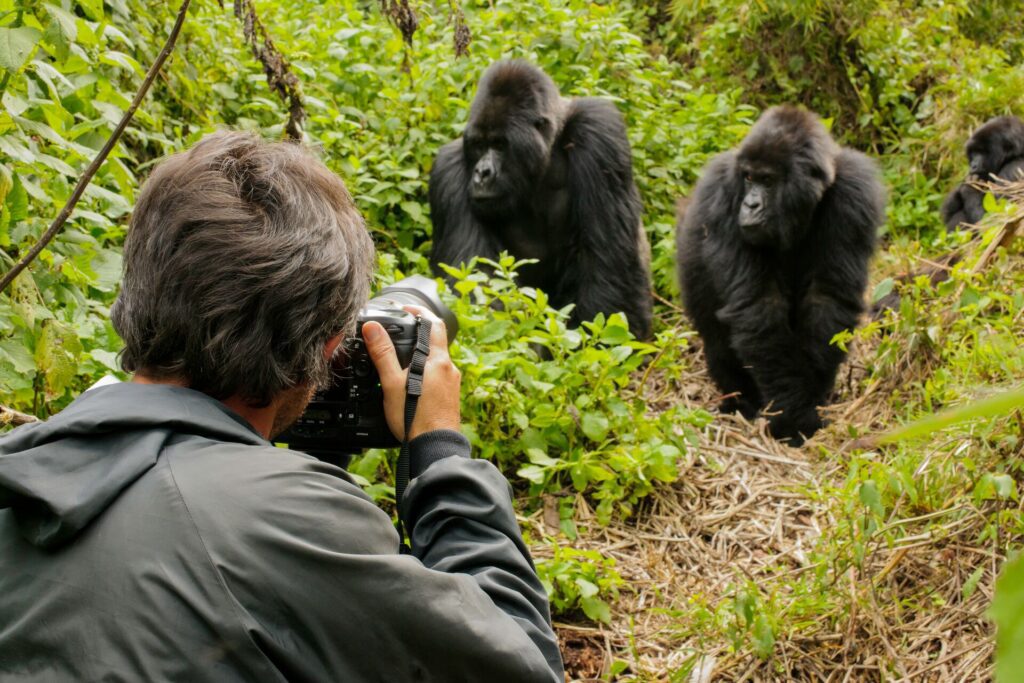
Your day begins with a mandatory registration and briefing session at the national park headquarters, usually around 7am. This is when park authorities explain all the safety rules and let you know which 8-person trekking group you’ve been assigned to. You’ll usually hire your porter around this time too, should you wish to.
You’ll then set off in your assigned group, accompanied by an experienced lead guide, an armed ranger or two, and gorilla trackers. Rangers are present on every trek in each of these parks to ensure the safety of both visitors and any wildlife you may encounter along your route.
The number of trackers accompanying each trek will vary, but there are usually at least two who head into the forest at dawn to locate the gorilla group. These specialists follow the animals from their overnight nesting sites and remain in radio contact with your trekking guides, who then lead your group to the gorillas’ confirmed location later that morning.
Once you reach the apes, you’re required to keep a minimum distance of 7m at all times, as you observe them feeding, resting, grooming and interacting. Sudden movements, loud voices, eating, touching the gorillas, or using flash photography are strictly forbidden.
Rangers and guides remain alert throughout your experience to ensure both gorilla wellbeing and visitor safety. If a gorilla shows signs of agitation or discomfort, your guides will calmly reposition the group. After one hour with the gorillas, you’ll quietly move away and retrace your steps back to park headquarters.
Packing List and What to Wear
No matter which season or park you choose for your gorilla trek, layering is key. Start with a lightweight, moisture-wicking thermal base such as a long-sleeved top and trousers; add insulation like a warm fleece for early mornings and cooler forest conditions, and top it with a waterproof shell layer to guard against unexpected showers, stinging nettles, thorny vegetation and insects. Ants, mosquitoes and forest flies are common on these treks, and while the risk of insect-borne diseases is low during the day, repellent is still recommended.
Sturdy, well-broken-in hiking boots with good grip and ankle support are non-negotiable. Gaiters will help keep mud and moisture out of them, while lightweight gloves can protect your hands as you move through dense vegetation. And a hat, sunglasses and sunscreen will keep you both comfy and protected.
Bring a small daypack with water, snacks, any personal medication and your camera. For bonus stability, walking sticks are often available locally near the parks’ briefing areas.
Gorilla Trekking Rules and Safety Guidelines
Gorilla trekking is tightly regulated to protect both gorillas and visitors, but the rules are straightforward and easy to follow. Group sizes are kept small (a maximum of 8 trekkers per gorilla group), and once you reach your gorilla family, you’ll have one hour to enjoy their company. During that time, you’re required to keep a minimum distance of at least 7m and flash photography is forbidden. Eating, drinking and smoking near the gorillas are also banned, and if you need to cough or sneeze you must cover your face and turn away, as gorillas are vulnerable to human illness. Take care not to accidentally litter, and always ask guides, porters, trackers, rangers and the local community for permission before you photograph them.
Gorilla Habituation Experience Explained
Keen to spend a little longer with these great apes? You’ll enjoy up to four hours with them if you take part in a gorilla habituation experience in Bwindi Impenetrable National Park. Unlike a standard trek, these specialised interactions introduce travellers to a gorilla group that is still in the process of becoming accustomed to human presence.
Accompanied by researchers, trackers and rangers who are actively involved in the long-term habituation process, you’ll get to see exactly how the gorillas respond to people, learn how scientists monitor their health and behaviour, and gain insight into the patience required to prepare these wild beauties for regulated tourism.
Because these wild creatures are less accustomed to humans, treks can be longer and more demanding, and strict protocols are enforced to minimise stress on the animals. Group sizes are limited to a maximum of 4 trekkers only, making permits highly sought-after and advance bookings essential. To learn more about this special experience, speak to Adventure World’s Africa Destination Experts on 1300 363 055 (AU) or 0800 238 368 (NZ).
FAQs About Gorilla Trekking
Here, five must-knows before you go…
Will I Definitely See Gorillas?
While sightings can never be guaranteed in the wild, gorilla trekking success rates in Rwanda and Uganda are typically well above 95 per cent. If a trek is entirely unsuccessful due to exceptional circumstances, local authorities may offer you a partial refund or the chance to trek again, depending on conditions and availability.
Can I Touch Gorillas?
No. Touching gorillas is strictly prohibited. A minimum distance of 7m must be maintained at all times to protect them from human-borne illnesses and to ensure their natural behaviour isn’t disrupted.
Do I Need a Porter?
It’s up to you, and really depends on your fitness and confidence on uneven terrain. That said, it’s strongly encouraged, as porters provide practical assistance on steep or muddy sections and your fee directly supports the communities at the frontline of gorilla conservation.
What Are the Minimum and Maximum Age Requirements?
The minimum age for gorilla trekking in both Uganda and Rwanda is 15. There is no official maximum age limit though, provided you’re physically capable of completing the trek safely.
What Are the Fitness Requirements?
You don’t need to be an athlete, but a moderate level of fitness is important for your safety and comfort. You should be comfortable walking for several hours on steep, uneven ground. Treks can involve sustained uphill and downhill sections, and preparation – like seeing your GP and doing regular walking, strength and cardio training before you travel – will help you get more out of your experience.
Travel Insurance Considerations
Not all policies will automatically cover gorilla trekking, so it’s important to check whether it’s included as an adventure activity and whether international evacuation cover is required. Speak to your preferred travel insurer beforehand to discuss your specific requirements.
Final Tips for Planning Your Gorilla Trekking Adventure
Australian and New Zealand travellers will need a visa to visit both Rwanda and Uganda; visit Smartraveller and Safe Travel for all the latest requirements and application details. English is widely spoken in both countries, particularly within the tourism sector. And speaking of speaking, you should do that with your GP or travel clinic before you leave home – because health precautions and vaccinations are needed (namely for yellow fever, hepatitis, typhoid and malaria). Comprehensive travel insurance – including medical evacuation cover – is essential.
While all these preparations will help you feel safe, healthy and comfortable throughout your adventure, nothing quite prepares you for the emotional impact of meeting gorillas in the wild, and not just for you. Because this one-of-a-kind trekking adventure plays a tangible role in supporting one of the planet’s most remarkable species, and the communities committed to their future – making this one of the most meaningful travel experiences you can ever have.
Book your ultimate Gorilla Trekking adventure today
Visit Adventure World online to explore our complete range of wildlife-focused holidays, or call our Destination Experts on 1300 363 055 (AU) or 0800 238 368 (NZ) to build a bespoke journey tailored to your interests.