
Recently updated on March 19th, 2026 at 12:35 am
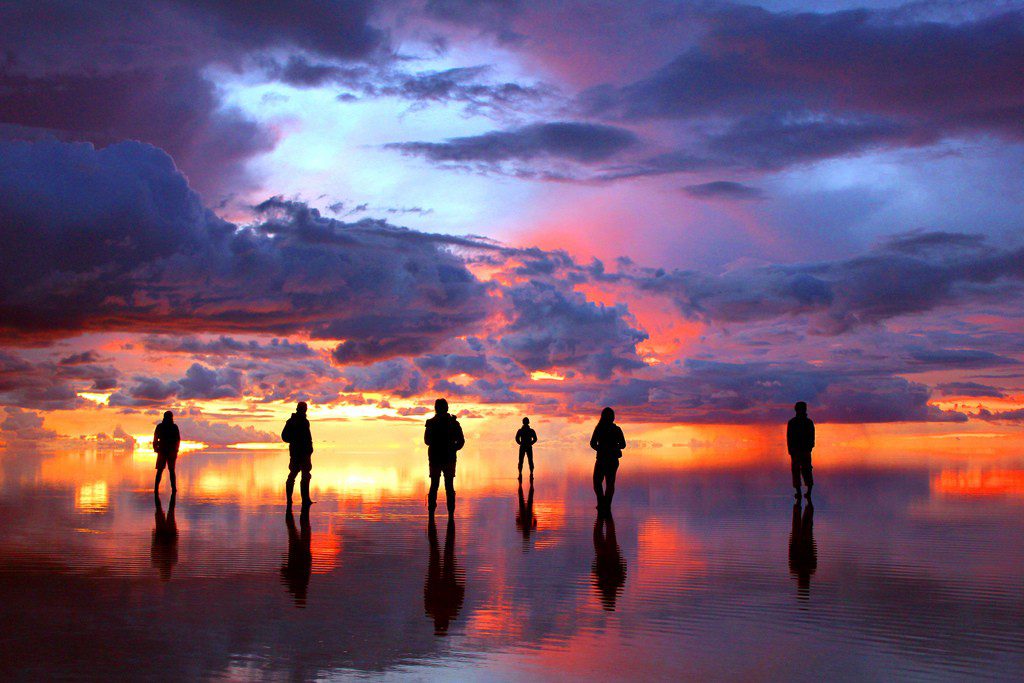
With their crystal vistas encrusting the horizon, the world’s largest salt flats are a high point of any visit to Bolivia – both figuratively and literally, as they sprawl across the high-altitude Altiplano (Andean Plateau). Locally known as Salar de Uyuni, this vast expanse formed when an ancient lake system evaporated and today it transforms with the seasons, forming sky-mirroring reflections in the wet months to a patchwork of salty geometry in the dry. So, while it’s a year-round destination, choosing when to visit Bolivia’s Uyuni Salt Flats will depend on exactly how you want to stay and play. Here, everything you need to know to get the timing right for your ultimate holiday experience.
Overview – Why Timing Matters for Your Uyuni Trip
Bordered by Peru, Brazil, Chile, Argentina and Paraguay in the landlocked heart of South America, Bolivia is home to the Amazon Rainforest and picturesque Lake Titicaca – but the Uyuni Salt Flats may well be its most lauded drawcard.
Covering some 10,582km² at 3,650m above sea level, this spectacular region shimmers in Bolivia’s southwest corner, 540km south of the capital La Paz (get your bearings this handy map).
Here, the climate is cold and dry rather than tropical, with daytime temperatures typically sitting between 7-16°C, then slipping to below freezing overnight, especially in the winter dry season. While more than 300,000 travellers come to the region each year, the dry season (May to November, covering winter and spring) is the most popular time and draws peak visitor numbers, while the wet season (December to April, which is summer and the first part of autumn) offers a quieter experience.
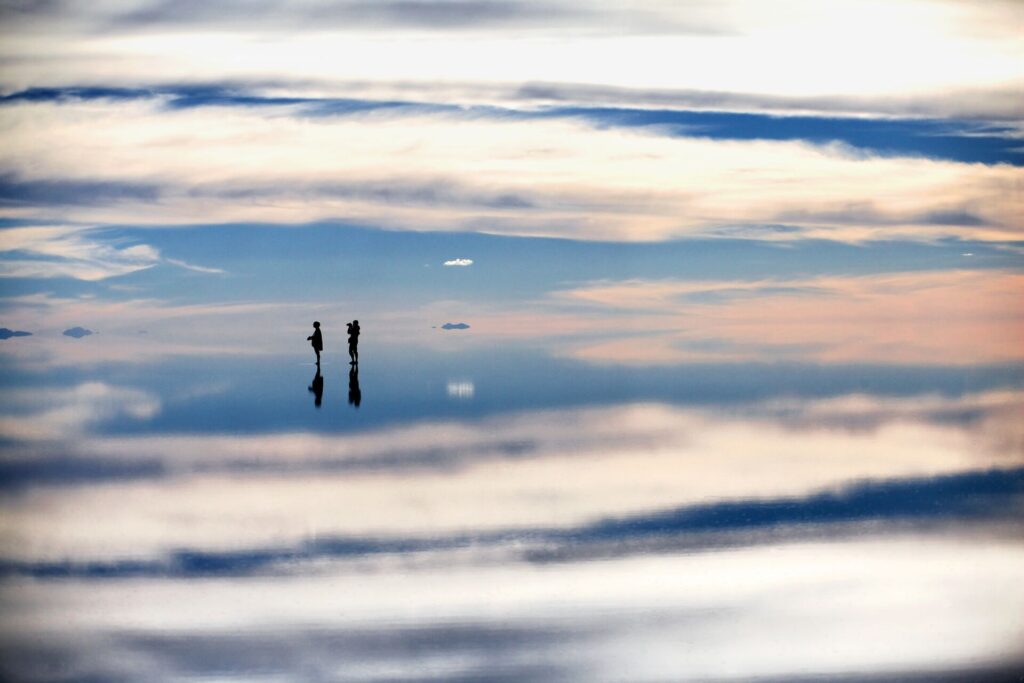
Uyuni Salt Flats in the Rainy Season (December-April)
Just add water for fewer visitors, extra-surreal scenery and weather conditions that’ll keep you guessing (and your camera clicking).
The Mirror Effect – Best Months for Stunning Reflections
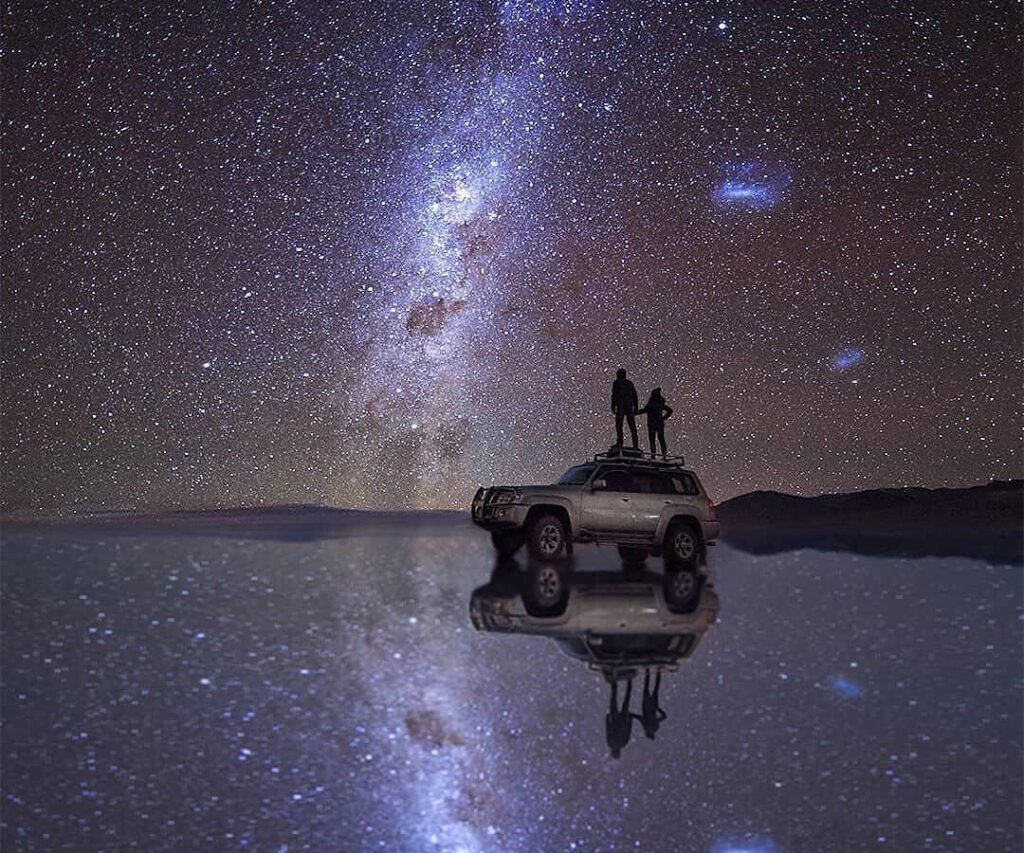
During the wet season a shallow layer of water spreads across the salt crust, turning the flats into a massive natural mirror. It’s rarely more than a few centimetres deep, but it’s just enough for the sky, clouds and Tunupa Volcano to reflect back with near-perfect symmetry, creating the illusion that the land and sky are dissolving into each other. These mirror-like conditions are most reliable from January to March, when rainfall is at its highest. This is an excellent time for photography and guided drives (when conditions allow), but even just a wander across this endless, floating horizon is an experience.
Pros and Cons of Visiting in the Wet Season
It’s rare for rain to fall all day long; instead, it usually arrives in short, intense bursts. Heavy downpours can occasionally flood sections of the flats and limit access, so some routes may close and itineraries need to be adjusted at short notice. Still, a key advantage of this season is being able to access salt-flat islands, like Isla Incahuasi, when water levels permit. So, while the logistics may be less predictable, fewer travellers, softer light and extraordinary reflections make the rainy season a memorable time to visit.
Adventure World’s fully customisable 4-day Uyuni Salt Flats & Coloured Lagoons holiday showcases the region’s most iconic experiences and departs all year round.
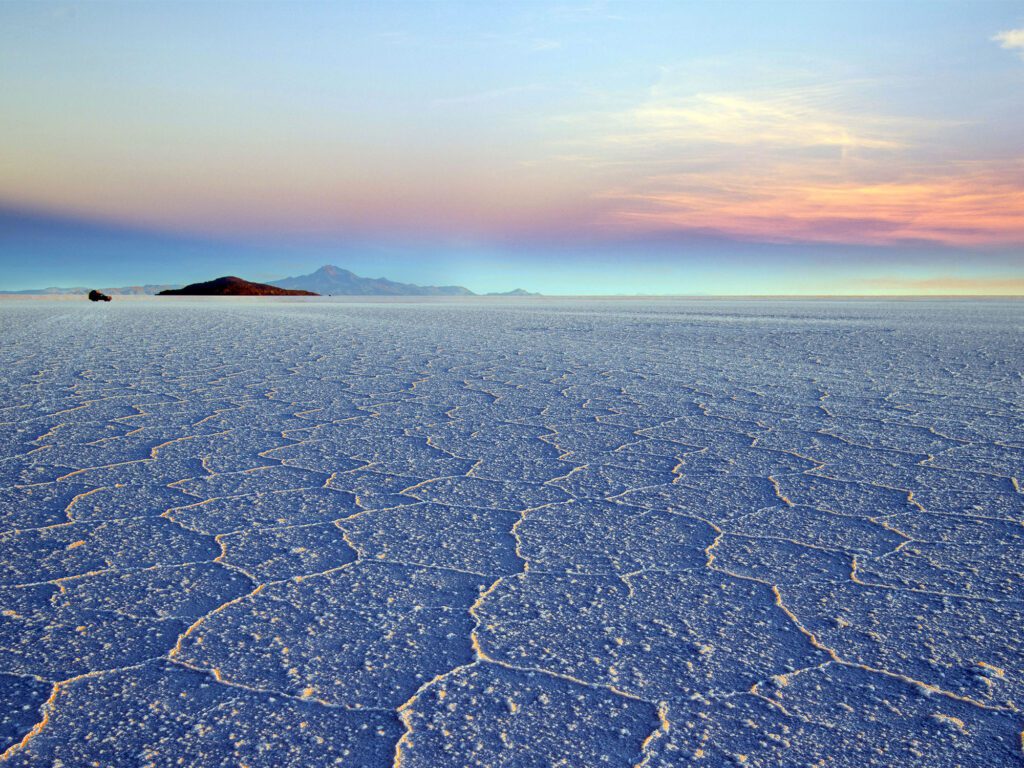
Uyuni Salt Flats in the Dry Season (May-November)
Winter and spring deliver the quintessential Uyuni experience: salt crunching underfoot, bright skies overhead and excellent access – along with cold, dry air and an influx of visitors.
Unique Hexagonal Salt Patterns
When the wet season’s waters dry up, the salt crust recrystallises into interlocking hexagonal shapes – each measuring around 1-2m wide – creating a briny honeycomb pattern that spreads across the region for several kilometres. In the early morning or late afternoon light, these geometric ridges cast longer, more defined shadows that add to the otherworldly atmosphere and keep photographers happily busy. Firmer ground at this time of year also means 4WD tours can comfortably and reliably cover much more of the region, making it easier to plan around sunrise and sunset excursion and venture further afield.
Pros and Cons of Visiting in the Dry Season
The dry season generally runs from May to November, but the peak of that peak season for travellers is typically July and August, when bookings can fill up quickly. Also, during this time, temperatures can get a little fresh: in Uyuni, July’s average daily high is 12°C, while the average low sits around -3°C. With Adventure World you can extend your exploration further to warm your bones in the Polques hot springs, near the Eduardo Avaroa Andean Fauna National Reserve in the southern highlands. It’s also worth noting that the air is especially dry in winter; so, to avoid dehydration, always carry plenty of water and, of course, sunscreen.
Spend a memorable week immersing in the very best of Uyuni, Lake Titicaca, La Paz and beyond with our fully customisable Authentic Bolivia itinerary.
Best Time to Visit Based on Activities
Uyuni is a year-round hotspot, so the best time to go really depends on what you most want to photograph, encounter and experience while you’re there.
Photography and Perspective Shots
For the classic mirror shots, plan for the wet season (December to April), when the rain creates a reflective surface to inspire your minimalist compositions, arty symmetry and playful perspectives, where you can make people and objects look like they’re floating or towering over the horizon. Calmer mornings and late afternoons often bring the cleanest reflections and softer light.
In the dry season (May to November), it’s all about capturing the texture of the interlocking salt polygons, conveying their scale and capturing their shadows; golden and blue hours will also add an extra layer of surrealism to your images. Whether you’re shooting with a smartphone or a DSLR with a wide-angle lens attached, nailing Uyuni’s bright white expanses can be challenging, so it’s a good idea to experiment with your exposure settings to keep detail in the highlights (instead of accidentally blowing them out).
Wildlife Spotting – Flamingos and More
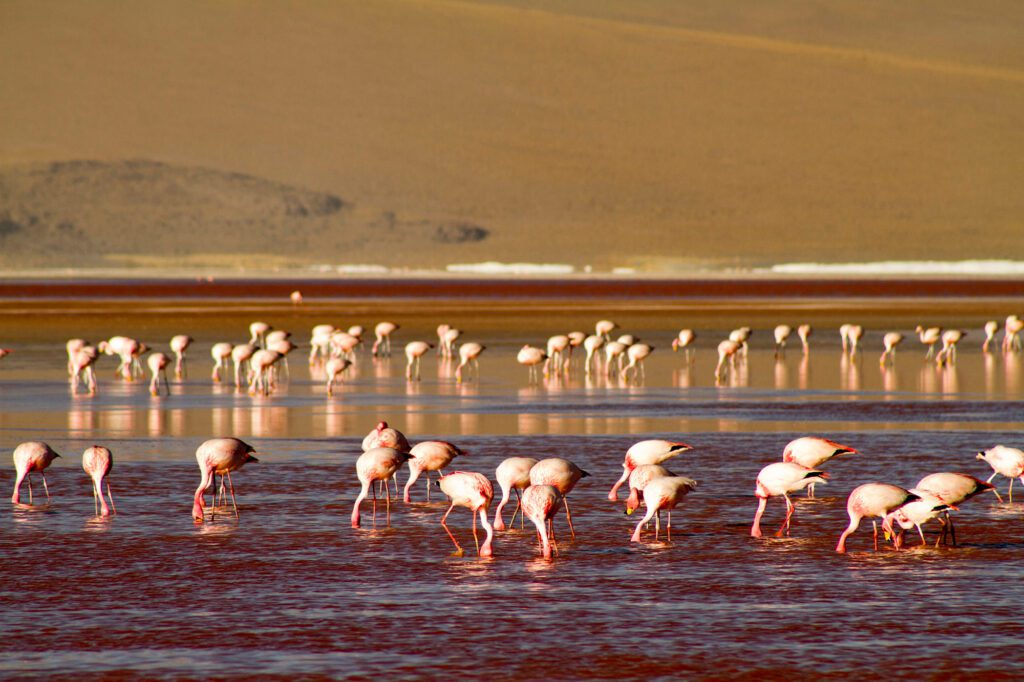
Salar de Uyuni itself isn’t a hub for wildlife, but the surrounding high-altitude lagoons and wetlands are. In the broader Uyuni-Lípez region (including the lagoons around Eduardo Avaroa Andean Fauna National Reserve), Andean, Chilean and Puna flamingos are a twitcher’s trifecta, with Laguna Colorada one of the standout locations to see them. Throughout the southern region, keep an eye out for Bolivia’s national symbol, the Andean condor, riding thermals along the jagged peaks, as well as hardy high-altitude mammals like vicuñas and Andean foxes between desert plains and lagoons.
Stargazing Over the Salt Flats
For exploring the night skies, the dry season is your best bet. Stable weather, minimal cloud and the sprawling salt flats create an uninterrupted horizon, offering an almost dome-like view of the sky. Plan your sessions around the new moon for the darkest skies, then look up: the Southern Cross is visible most of the year and is especially striking in autumn evenings, while Scorpius and Sagittarius light up the winter nights. Jupiter and Saturn are also often visible to the naked eye, and this is also prime Milky Way territory: its bright galactic core is most clear to see between June and September. For an extra-extraordinary astro adventure, time your visit for 6 February 2027, when a partial solar eclipse will be visible from parts of Bolivia, including the Uyuni region.
Over 16 days, our Authentic Peru & Bolivia pairs the Uyuni Salt Flats with Machu Picchu, Lake Titicaca and more regional highlights across two magical countries.
Travel Tips for Visiting Uyuni
Get a handle on these essentials to make the most of your Bolivia adventure.
How to Get There
Fly into La Paz, Bolivia’s capital city, then take the hour-long domestic flight to Uyuni Joya Andina Airport. The town of Uyuni itself is the main base for exploring the salt flats and the jumping-off point for multi-day journeys deeper into the Altiplano and southwest region. Adventure World’s 4-day Uyuni Salt Flats & Coloured Lagoons itinerary is customisable, so you can enjoy it on its own or incorporate it into a wide range of Bolivia and South America itineraries. Call our Destination Experts on 1300 363 055 in Australia or 0800 238 368 in New Zealand to explore your tailor-made options.
Where to Stay
Accommodation around Uyuni ranges from simple lodgings in Uyuni town to atmospheric stays built directly on or near the salt flats. Staying locally is your best bet, because this reduces your daily travel time, allows for early starts when light and conditions are at their best, and makes things much easier if you need to adjust plans due to weather changes. Adventure World’s itineraries typically include nights in handpicked boutique stays – including, in the Uyuni region, a unique hotel built out of salt blocks – and visits to various highlights, such as Coquesa’s ancient tombs, the hot springs of Polques, Laguna Colorada, the Siloli Desert, and the quaint village of Colchani, where you’ll experience the traditional art of extracting salt by hand.
What to Pack for Each Season
Travelling at altitude may also cause some discomfort, so it’s wise to speak to your GP about what medication to bring with you to help in the case of altitude sickness. And, a reusable water bottle, sun protection, sunglasses (preferably polarised) and a small backpack for your daily activities will be your MVPs no matter when you visit Bolivia’s Uyuni salt flats. In the wet season, you’ll also need to bring waterproof footwear, quick-dry clothing, a rain jacket, and weatherproof protection for your camera gear and phone. In the cold, dry season, warm layers are non-negotiable, especially for early mornings and nights when temperatures can drop sharply. Pack your gloves, a beanie, insulated outerwear, and plenty of lip balm to counter the effects of the dry, high-UV conditions.
Our 11-day The Inca Route: Lima to La Paz holiday is an immersive journey through ancient Peru and Bolivia, connecting the Uyuni Salt Flats to local history, culture and striking natural scenery along the way.
Summary – Choosing the Right Time for You
All in all, deciding when to visit Bolivia’s Uyuni Salt Flats comes down to the kind of magic you’re after. If you’re hoping to experience the world’s largest natural mirror with fewer travellers around, and are happy to stay flexible as weather conditions evolve, pack your bags for the wet season. Prefer to immerse yourself in surreal natural geometry, enjoy easy access across the region and soak up big blue skies? The dry season is your best bet. Better still, aim to come more than once – because, all year round, there’s a new experience to savour in this remarkable pocket of South America.
Our 24-day Authentic South America adventure is a multi-country journey through the continent’s major cities, cultural icons and most jaw-dropping landscapes, including the Uyuni Salt Flats.
Book your ultimate Bolivia adventure today
Visit Adventure World online to explore our South America itineraries, or call our Destination Experts on 1300 363 055 (AU) or 0800 238 368 (NZ) to start planning a bespoke journey tailored to your interests.