

Recently updated on September 7th, 2026 at 03:12 am
Giant otters, capybaras, giant anteaters, Earth’s highest density of jaguars… you can expect very big things from the world’s largest tropical wetland. You’ll find them all and more in our comprehensive travel guide to why you should visit Brazil’s Pantanal region – from the creatures you’ll see to how you can MAKE TRAVEL MATTER®, and every wildly rewarding adventure in between.
Overview – What Makes the Pantanal Special
Brazil’s World Heritage-listed Pantanal Conservation Area encompasses some 187,818ha of lakes, rivers, plains and forests in the country’s rugged heart, where it straddles two states (Mato Grosso and Mato Grosso do Sul). The northern sector (Mato Grosso) is usually accessed via Cuiabá, while the southern Pantanal (Mato Grosso do Sul, which covers around two-thirds of the region’s total area), is reached from Campo Grande.
Recognised globally as Earth’s largest tropical wetland and one of the world’s largest freshwater ecosystems, the Pantanal’s terrains are constantly in flux and reshaped by seasonal floods. In the wet season (October to April) rivers spill into lagoons and shallow lakes, then when the dry season arrives (May to September) these retreat to reveal open plains, forests and islets. This constant ebb and flow creates a wide patchwork of habitats, allowing for consistent wildlife viewing across land and water – in fact, many elusive and reclusive animals can be easier to spot in the Pantanal than in many other South American wildlife hotspots.
Track elusive big cats through Brazil’s best wildlife destination on our 5-day Jaguars of the Wild Pantanal holiday – and MAKE TRAVEL MATTER® for them with unique conservation experiences.
Marcos with Oncafari Jaguar Safari encountering Malala, a jaguar in the Pantanal, for the first time after the 2024 wildfires.
Reasons to Visit Brazil’s Pantanal
There are almost as many reasons to visit the Pantanal as there are species in this epic wilderness – but here’s a hint of the highlights the hotspot offers.
1. It’s One of the Most Biodiverse Regions on Earth
The Pantanal’s extravagant ecology is evident as far as your eye can see on any given day, so on every adventure you’ll explore a variety of environments rather than a single uniform one. The mighty Paraguay, São Lourenço and Taquari rivers, oxbow lakes, seasonally flooded grasslands, reed-fringed lagoons, open savannahs, swamps and forests create an ever-changing mix of wet and dry habitats where wildlife viewing feels especially fruitful. And indeed, it is: the Pantanal is home to around 3,500 plant species, alongside 159 mammals, 656 bird species and 98 reptiles. Wildlife-spotters usually come for jaguars, giant otters, giant anteaters and capybaras; birders are rewarded by hyacinth macaws, toucans and jabirus, while reptiles like yacaré caimans and anacondas ensure the awe of all. It all adds up to create one massive wild arena where ‘big-ticket’ sightings are a lot easier to come by.
2. The World’s Largest Tropical Wetland
While Brazil’s officially designated Pantanal Conservation Area is almost the same size as the Australian Capital Territory, the wider Pantanal region is much larger, extending into neighbouring Bolivia and Paraguay. It’s shaped by the 2,550km-long Paraguay River and fed by a number of its key tributaries, including the Cuiabá, São Lourenço and Taquari. But, rather than forming a single marsh, these waterways weave across an immense floodplain to form an intricate network of channels, permanent wetlands, lagoons and lakes, alongside seasonally flooded savannahs and grasslands that expand and shrink throughout the year. Most of this water is fresh, but parts of the southern Pantanal – especially the Nhecolândia subregion – are distinctive for their saline-alkaline lakes. These aren’t ‘brackish’ in the coastal sense; they’re inland soda lakes that can have very high pH, attracting everything from vibrantly plumed roseate spoonbills and migrants like ospreys and upland sandpipers.
3. Spot Majestic Jaguars in the Wild
Weighing up to 160kg and reaching 2.7m in length (including that beautiful tail), jaguars are the Americas’ largest big cat. The species is listed as Near Threatened, and in recent decades it has lost ground, with its overall range found to be shrinking.
The Pantanal is famous for its unusually good odds of seeing one, mostly because the wetland’s open floodplains and river margins bring both prey and predator together in concentrated numbers. In parts of the region, recent camera-trap research has confirmed that there can be up to 12.4 jaguars per 100km², which helps explain why sightings can feel relatively frequent. You’ll still need a sharp eye to see one, though – they’re typically solitary and territorial, and while they can be active in daylight, they’re primarily nocturnal. Plus, their golden coats are patterned with black rosettes (often with a central spot), which helps them disappear into dappled shade along the riverbanks.
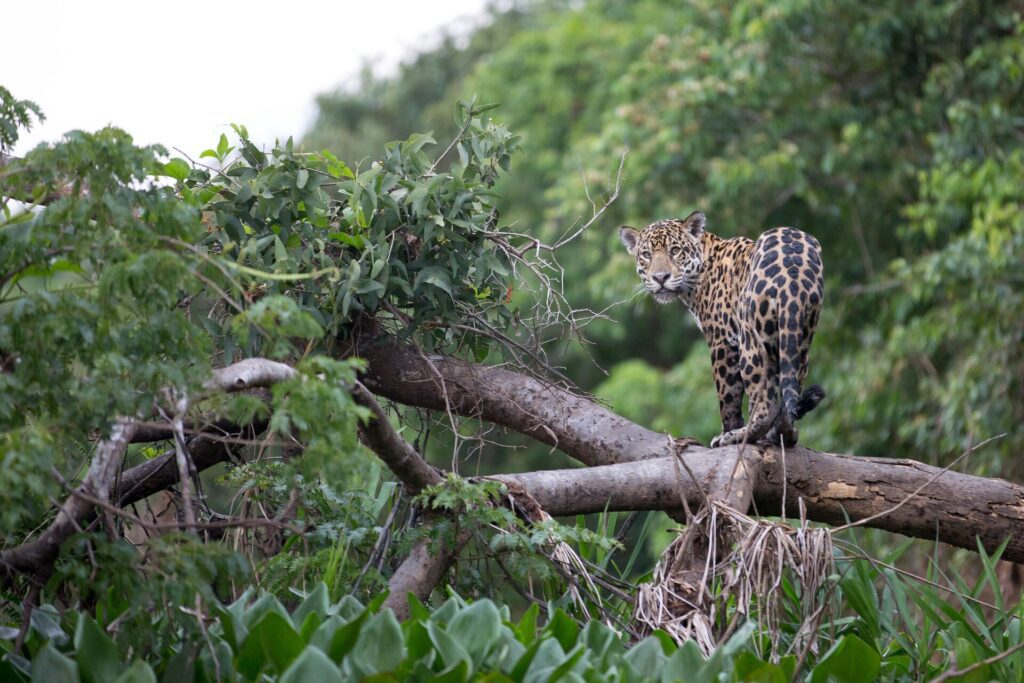
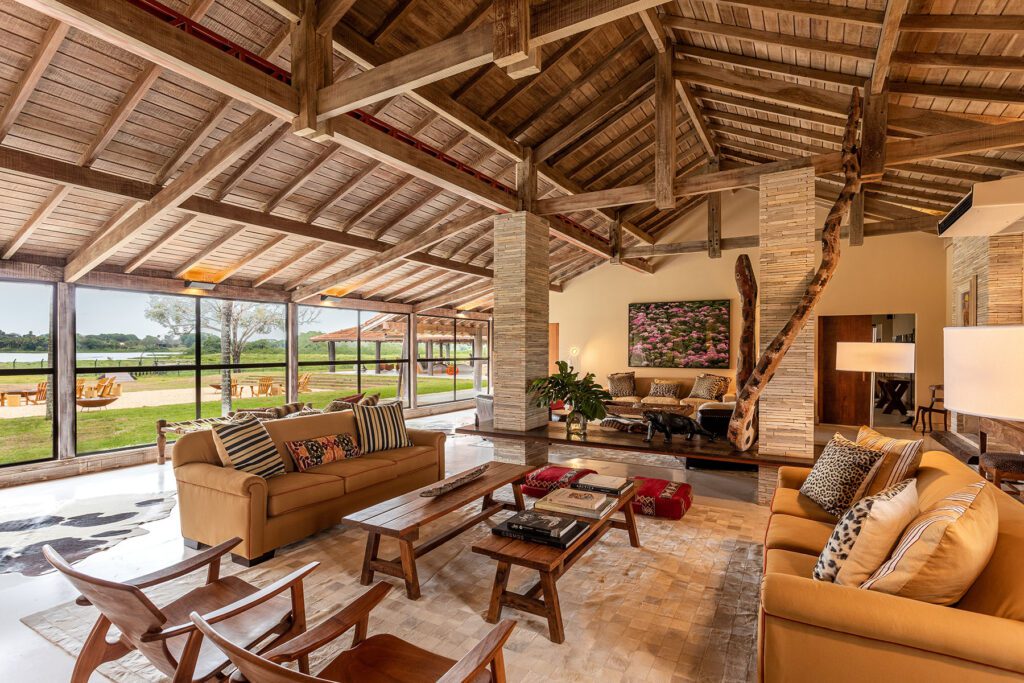
Ready for a wild prowl of your own? On Adventure World’s Jaguars of the Wild Pantanal itinerary, you’ll step into the world of these elusive big cats and MAKE TRAVEL MATTER® for them. You’ll stay at Casa Caiman within the 53,000ha Caiman Ecological Refuge – home to the Onçafari Project – then head out on expert-led safaris and jaguar tracking by open 4WD, with your time in the field designed around conservation-led wildlife viewing that gives back to these wild beauties and the community securing their future.
Pair your Pantanal holiday with our customisable 10-day Authentic Brazil itinerary for the ultimate adventure through wilderness, wildlife and culture.
4. See Toucans in Their Natural Habitat
The toucan family includes around 50 species worldwide – from the big-billed toucans to the smaller araçaris. In the Pantanal, you’re most likely to come across two standouts: the toco toucan is the most sought-after, measuring around 55-61cm, with a glossy black body, a crisp white throat, a flash of red under the tail, and a ginormous orange beak tipped with black. The chestnut-eared araçari is significantly smaller (around 43-47cm) and more delicately built, with a dark head and chestnut ‘ear’ patch, green upperparts, yellow underparts crossed by a red band, and a yellow-orange stripe on its dark beak. Look for both along the edges of riverine forests, palm-rich areas, and around fruiting trees close to the waterline. Toucans can be active throughout the day, but to see them, it’s worth opening your ears first – they’ll often give themselves away with loud calls as they move through the canopy.
5. Witness the Hyacinth Macaw – the Largest Parrot Species
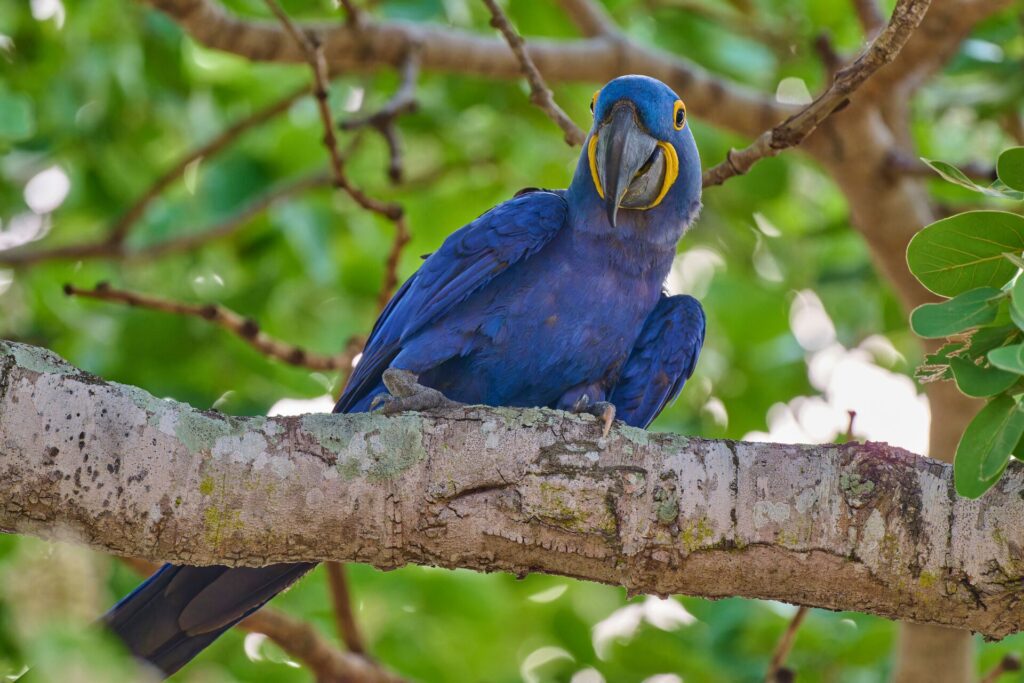
Across the Americas there are 18 species of macaws – large, colourful, long-tailed birds in the psittacidae family – but the hyacinth macaw is in a category all of its own, being the world’s largest parrot and growing up to 100cm long. Listed as Vulnerable, today’s wild population is estimated to be between 4,300 and 6,500 individuals, with the Pantanal recognised as a major stronghold thanks to its long-running conservation initiatives.
Look for hyacinths in palm-rich areas where they feed on hard nuts, and near their major breeding sites in the southern sector – including the Caiman Ecological Refuge, where they nest in the hollows of the manduvi tree. Hyacinths are non-migratory, so you may encounter them year-round, but while you’re scouting for that telltale cobalt-blue flash in the canopy, you might also spot blue-and-yellow macaws or their red-and-green counterparts.
6. Experience the Abundance of Caimans
The crocodilian you’ll find here is the yacaré caiman – a member of the alligator family, rather than a true crocodile. Adult males typically measure around 2-2.5m, while the females are slightly smaller. You’ll find them far and wide throughout the region, with population surveys across the Brazilian Pantanal suggesting they number in their millions – which, for wildlife lovers, means regular sightings around quiet lagoons, oxbow lakes and along riverbanks. Viewing is especially rewarding when the water levels drop in the dry season and the reptiles concentrate around shrinking pools, before spreading out again when the rains come. Caimans are generally far less of a human risk when compared to Australia’s saltwater crocodiles, but they’re still wild and snappy – so give them plenty of space, particularly around their nesting areas. And it’s worth keeping an eye out for jaguars when you’re watching caimans, too – chances are, the big cats may also be watching them to size them up for a feed.
Want to explore Brazil’s top wilderness regions on the one holiday? Extend your Pantanal adventure with a stay at the legendary Juma Amazon Lodge.
7. Watch Playful Giant Otters
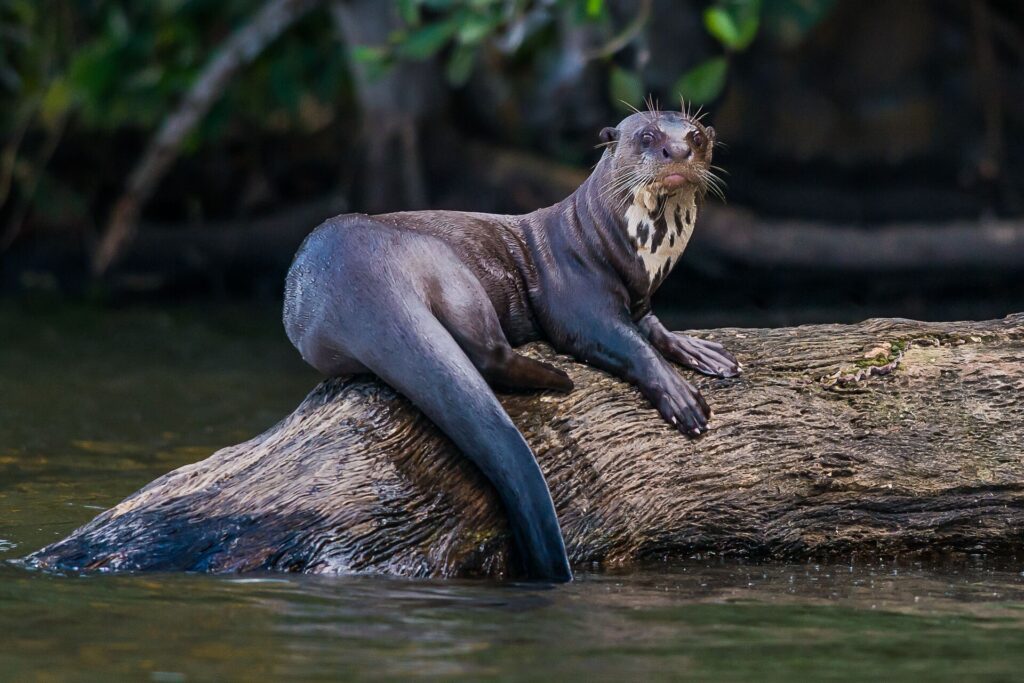
Giant otters have personalities as large as their name would suggest – they’re animated, vocal and intensely social, often travelling as a family group built around a breeding pair and their young, and staying in touch with a running commentary of chirps and whistles. The Pantanal remains a stronghold for these 1.5-1.8m Endangered beauties, with long-term research suggesting there may be around 4,000 individuals here.
For your best chance of finding them, focus on quieter waterways and backchannels in the southern Pantanal – especially stretches of the Miranda River, where field studies have tracked multiple groups over the years. They’re primarily active in daylight so keep an eye on the water: you may see them hunting fish, swimming, hauling out to groom, and relaxing in and around their waterside dens.
8. Encounter Giant Anteaters in Open Plains
Listed as Vulnerable, the giant anteater looks almost unreal up close, thanks to its long snout, bold black-and-white shoulder stripe, huge foreclaws that force it to walk on its knuckles, and a coarse shaggy coat. Adults are typically about 1m in body length, with a sweeping tail that can add up to about 90 centimetres.
In the Pantanal you’ll most often spot one in the open grasslands and along seasonally flooded plains – including around Nhecolândia – often in the drier months, when more of the plains are exposed and accessible. They can be active day or night, but they tend to adjust their activity to each day’s conditions – when it’s hot, they’re more likely to use shade and become more active in the cooler hours, so you may find them later in the day. Keep an eye out for them during any 4WD adventures, especially when travelling on tracks near the forests’ edges, where there’s plenty of shade and cover.
9. Discover Elusive Armadillos
Armadillos are the Pantanal’s armoured diggers: compact mammals draped in articulated plates that help protect them as they excavate burrows and tear into termite mounds with their powerful claws. The region is home to five recorded species – from the Vulnerable giant armadillo to more widespread species listed as Least Concern. If Lady Luck’s on your side, you might even a glimpse of the Near Threatened southern three-banded armadillo), one of only two living armadillo species that’s able to roll into a near-perfect ball when it’s feeling threatened. Armadillos are typically nocturnal (and often keep even later hours in hot weather), so your best bet is to keep an eye on any slightly higher ground flanking the floodplains – especially near forests or in their clearings – scanning for fresh diggings, burrow entrances, and a low, slow shuffle through the leaf litter.
10. Learn About the Myths and Reality of Anacondas
Anacondas have a knack for turning up in tall stories – mainly as cunning hunters that go to great lengths to nab a human snack. In reality, encounters with people are pretty uncommon: these non-venomous constrictors are water-preferring ambush predators, that feed on fish, shorebirds, small mammals and caimans, and they’re usually hunt from dusk onwards. In the Pantanal, you may be lucky enough to see a green anaconda (which is listed as Least Concern) in its vegetation-rich wetlands and slow-moving waterways.
Size-wise, green anacondas are among the largest snakes on Earth and can reach up to 9m metres and 250kg – but still they can be quite tricky to spot. For your best chance, speak to your experienced local guide about any recent sightings, then take your time to scan lagoons, marshy backwaters and slow-moving channels for a thick body draped along the edge – or a head breaking the surface among floating plants. Also be aware that they can remain fully submerged for about 10 minutes, often holding their position with just their eyes and nostrils near the surface. If you’re lucky enough to spot an anaconda, give it plenty of space and follow your guide’s instructions at all times, for your safety and theirs.
Adventure World’s Brazil holidays are tailormade to suit your interests; chat to our Destination Specialists on 1300 363 055 about how you can stay, play and MAKE TRAVEL MATTER® your own way.
Best Time to Visit the Pantanal
The Pantanal experiences two key seasons: a wetter stretch from roughly October to April (spring through to early autumn), and a drier period from May to September (late autumn through to early spring), when floodwaters retreat. In the southern Pantanal around Corumbá, temperatures average around 27°C across the wetter months, alongside roughly 840mm of rain in total for the October-April period; compared with around 23°C and 160mm across May-September.
The dry season brings standout wildlife opportunities because as the water levels drop, animals aggregate around the remaining channels and lagoons. It also usually means there’s less mud and fewer flood-related detours to contend with, but there’s also more risk of bushfires late in the season – so be sure to double-check current conditions before you travel.
By contrast, the wet season can make wildlife a little trickier to pin down across the wider floodplain, but it delivers lush conditions and flowing waterways – with the trade-off being that flooding may occasionally put a dampener on your daily plans.
Weighing up whether you should pair your Pantanal holiday with a trip to the Amazon? Our blog Why You Should Visit the Amazon, reveals all the ins and outs to remove any doubts.
Ana Salazar’s, our South America Product Manager, personal encounter with Malala, a Jaguar in the Pantanal.
How to Get There and Travel Around
For clarity’s sake, it’s worth thinking of the Pantanal as being split into two parts, namely the north (Mato Grosso) and south (Mato Grosso do Sul) sectors, with around two-thirds of the Brazilian Pantanal lying in Mato Grosso do Sul. For the northern Pantanal, you’ll typically fly to Cuiabá from Rio de Janeiro or São Paulo, then travel onwards by road. For the southern sector, you’d fly from Rio or São Paulo to Campo Grande. From there, it’s 236km (about 3.5 hours’ drive) to Miranda, the gateway to the Caiman Ecological Reserve.
Whichever region you choose, independent road travel can be tricky to navigate; plus, as large sections of the Pantanal are privately owned, gaining access to key wildlife areas isn’t always a simple process, so it should be left to the experts to arrange on your behalf. This is where Adventure World works its magic, and you can rest assured all your on-the-ground logistics are covered. Whether you’re customising one of our existing itineraries or building your own from scratch, our holidays may include transfers, local transportation, permits as required, expert local guides, handpicked accommodations, many meals, and various sightseeing experiences – including many that MAKE TRAVEL MATTER®.
Essential Tips for Visiting the Pantanal
Three practical need-to-knows before you go.
You’ll probably need a visa.
Australians need to arrange a visa before arrival for Brazil, and entry rules can change with little notice – keep an eye on Smartraveller for the latest requirements and updates. New Zealand passport holders can visit Brazil for tourism without arranging a visitor visa in advance (for shorter stays), but it’s still wise to check current entry conditions on Safe Travel before you fly.
See your doctor beforehand.
Book a pre-travel appointment to talk through vaccinations and mosquito-borne risks – your GP or travel clinic will advise what’s appropriate for your route and your season of travel, including whether malaria medication is needed for the regions you’re visiting.
Make the most of your time in Brazil.
Consider pairing your Pantanal trip with its equally heavyweight counterpart, the Amazon (including Adventure World’s Juma Amazon Lodge stay) or by adding Iguazú Falls for a completely different type of water-based rush. If Rio de Janeiro tops your list, build your holiday around the annual Carnival, then kick back and relax in Paraty and Ilha Grande.
Whichever way you mix and remix your Pantanal itinerary, you’ll see it becomes not just a wildlife and wilderness highlight in its own right, but also an iconic starting point for experiencing Brazil in all its living colour.
Book your Pantanal holiday today
Adventure World’s authentic South America itineraries are fully customisable and take you deep into the wildest heart of Brazil, Ecuador, Peru and beyond. Visit us online to learn more, or call our Destination Specialists on 1300 363 055 (AU) or 0800 238 368 (NZ) to plan your ultimate wildlife adventure today.